

I recently went on a trip with a friend and her dog. It is a tiny Yorkshire terrier, a year and a half old, affectionate, sweet, and so ridiculously adorable that complete strangers would stop to admire her everywhere she goes. On the street, in cafés, in hotel lobbies - she attracts attention like a little celebrity.
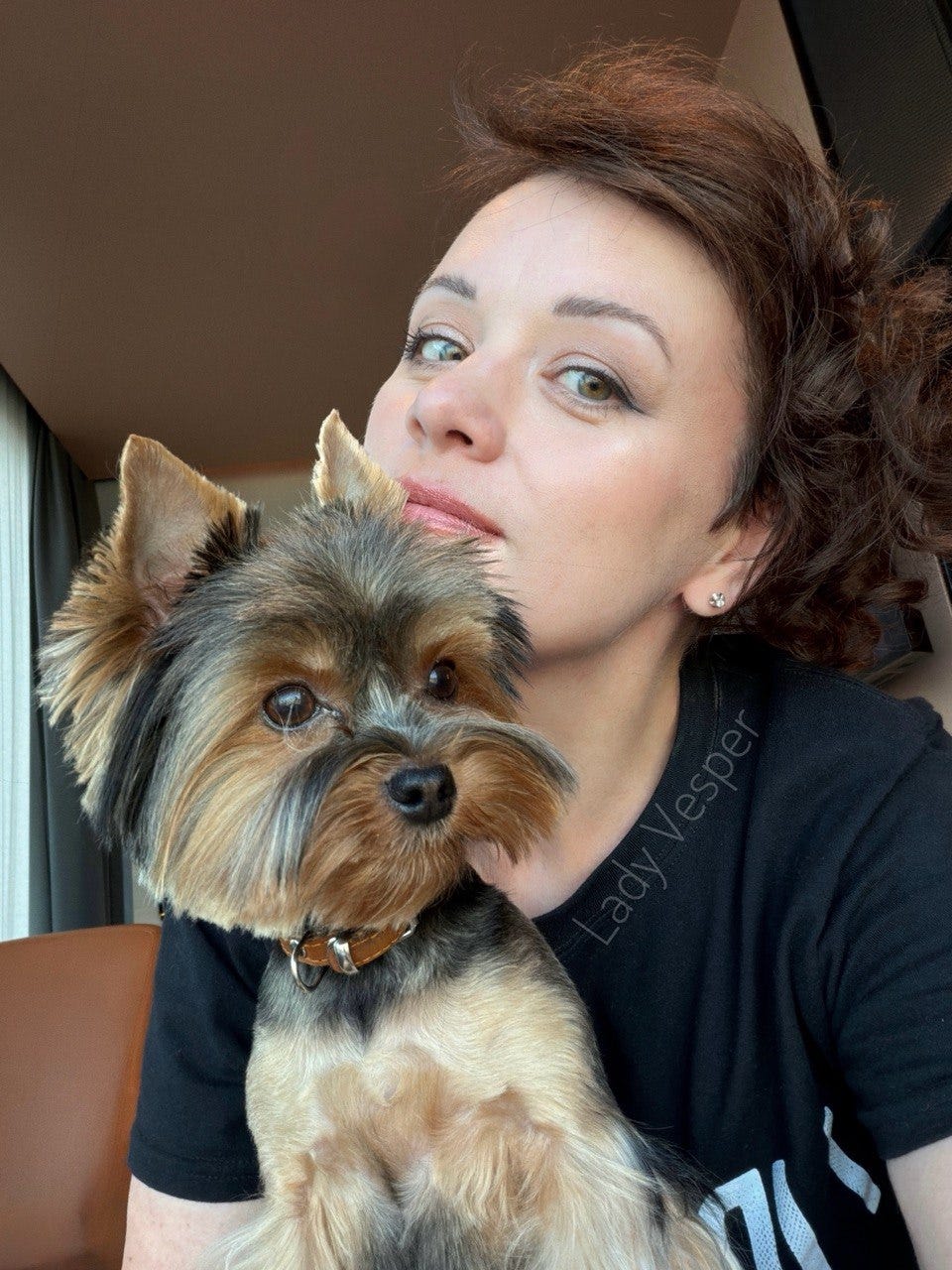
She is also almost completely untrained.
My friend has taught her to sit or stand on her hind legs when there is a treat shown. The problem appears when obedience actually matters. Telling her to sit in a café so she doesn’t get under the staff’s feet was a completely pointless. Calling her back outside when there are cars nearby didn’t work either.
And watching the two of them together made me think a lot about dominance, submission and the process of training.
Control starts with yourself.
Dog training is obviously more complicated than simply having a strong personality. Dogs learn through consistent cues and reinforcement, and a command successfully performed at home does not automatically transfer to a new environment full of distractions.
But consistency is exactly where my friend struggles.
She is one of those people who constantly forgets things, gets distracted, changes direction halfway through something. She also lives with quite a few contradictions inside herself - part of her desperately wants freedom, while another part craves social approval and constantly tries to be a “good girl.”
When your own values pull you in different directions, consistency becomes very difficult. Your decisions change according to which voice happens to be louder that day, and maintaining rules for another living creature requires considerably more effort.
This is where a tiny Yorkshire terrier unexpectedly made me think about submissive’s training.
Adult submissive men are obviously infinitely more complicated than a one-and-a-half-year-old dog. Yet one principle applies remarkably well to both situations:
You cannot consistently exercise control over another living being when you cannot consistently exercise control over yourself.
What exactly are you trying to create?
A well-known kink educator I frequently reference, Ms. Elle X, has created an entire series about the parallels between dog training and submissive training.

She isn’t talking about pet play. Her focus is dominance itself: consistency, communication, reinforcement, boundaries, and understanding what behavior you are ultimately trying to cultivate.
That last part matters enormously.
A Domme who wants to train an excellent submissive first has to know what an excellent submissive looks like TO HER.
There is no universal answer. Perhaps she wants strict obedience and elaborate rituals. Perhaps she cares much more about practical service or financial devotion. Another Dominant may value emotional intimacy, sexual submission, or a completely different combination.
Whatever the answer is, the Domme needs one. Otherwise, what exactly is she training him toward?
Training requires direction. Direction requires a destination. If your own desires remain vague or constantly change according to guilt, external approval, or whatever BDSM discourse told you a “good Domme” should want, your submissive receives conflicting signals.
And no good training can be based on that.
A submissive cannot find stability in your contradictions.
This becomes particularly obvious when a Dominant’s stated desires collide with what she actually believes about herself.
If she demands worship while secretly wondering whether she deserves even a small gift, how comfortably will she receive sincere offerings?
If she embraces her sadism one evening and wakes up feeling guilty and a bad person the next morning, what does her submissive learn about giving her his body for pain play?
If she establishes rules because they genuinely please her and then abandons them whenever enforcing them becomes uncomfortable, why should her submissive take the next rule seriously?
If she says that the dynamic revolves around her desires while constantly adjusting those desires to keep him occupied and engaged, whose desires are actually directing the relationship?
This doesn’t require a Dominant to become some perfectly self-actualized creature who never doubts herself. I certainly don’t qualify for that position, and I don’t know anyone who does.
Self-control means something much more practical to me. You need enough awareness of your own desires and values to recognize when you are contradicting them. You need enough discipline to tolerate the discomfort that sometimes comes with standing by your decisions.
Changing your mind is perfectly fine. Learning something about yourself and changing the rules accordingly is part of being human. What matters is knowing WHY you changed them.
Control requires consistency.
People often associate dominance with giving commands, setting rules, imposing punishments, or deciding what another person is allowed to do.
Those are expressions of control. The foundation underneath them is consistency.
If I establish a rule for my submissive, I need to understand why that rule exists. If he violates it, I need to notice. If I decide that an exception makes sense, I should understand why I am making that exception rather than quietly abandoning my own standard because enforcing it suddenly feels uncomfortable.
The same principle applies to rewards and correction. A submissive cannot learn what pleases his Dominant when identical behavior produces wildly different reactions depending on her mood, insecurity, or need for approval.
Leadership requires a destination.
There is another reason self-control matters so much to dominance.
If I am leading someone, I need to know where I am taking them.
I don’t believe submissive training means gradually molding every man into some universal ideal of submission. I am training MY submissive to serve ME. The entire process therefore depends on knowing what I value and what kind of relationship I want to create.
What behaviors make my life better?
What qualities do I want to encourage?
What privileges am I willing to give in return?
Which behaviors will make me lose interest in someone entirely?
Those answers become the map.
Without that map, dominance can easily slip into a collection of commands that happen to feel exciting in the moment. There may still be wonderful scenes and intense emotions, but long-term training requires something more stable than momentary inspiration.
It requires intention.
I never tried to train my friend’s dog during our trip. This isn’t my dog, and interfering with someone else’s relationship with their animal would have been both disrespectful and pointless.
Still, something rather amusing happened.

By the end of the trip, this tiny creature had started sleeping at my feet. She followed me around and sometimes came after me even while her owner was actively calling her back.
When I told one of my submissives about this, they laughed and said:
“Dogs instinctively submit to the alpha.”
I wouldn’t use that as a serious theory of dogs behavior. Perhaps the dog simply liked me. Perhaps I was novel and interesting, or perhaps she discovered that staying close to me was pleasant.
But this joke stayed with me because there was something underneath it that I recognized:
Control doesn’t begin when someone kneels.
It begins much earlier, inside the person they choose to kneel for.
Before I can expect another human being to follow my will, I need to know where my own will is going.

So true. Does remind me of Emily Post for subs😊
Control doesn’t begin when someone kneels.It begins much earlier, inside the person they choose to kneel for. ❤️🔥